

Somewhere in your organization, a project plan has a go-live date on it.
Someone picked that date because of a budget cycle, a vendor's availability, or a fiscal-year deadline. Rarely was it chosen by asking whether the teams receiving the change could absorb it.
I've been in the meetings where the date gets locked. The readiness question comes up once, somebody says, "They'll be fine," and the conversation moves on.
It usually doesn't come up again until something goes sideways.
The Date Isn't the Problem. How It Was Chosen Is.
In the last article, I looked at McKinsey's 2021 survey of 1,034 people who had participated in an organizational transformation.
Respondents reported that 22% of potential value loss occurred during the target-setting phase, before implementation began.[^1] The report's title, Losing from Day One, makes the same point: value can start leaking before the transformation is fully underway.
A go-live date is a target. If it is set without considering the teams it will affect, that date can become one of the first places value leaks.

Readiness Is a Set of Questions, Not a Mood
People sometimes talk about readiness like a vibe. Either the team seems receptive or it doesn't.
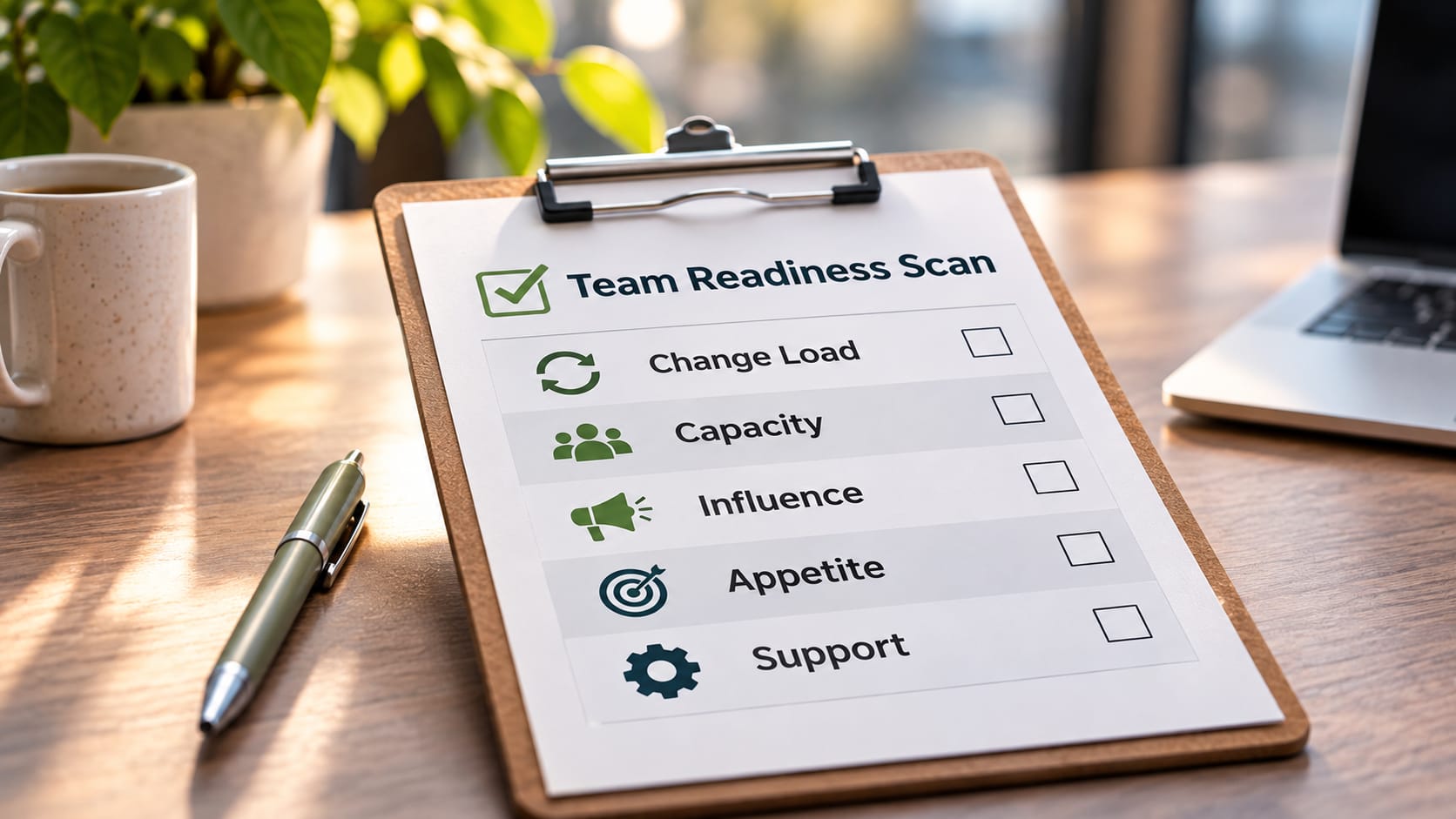
I treat readiness as five questions. The answers change team by team, not company by company:
- Change load: How many tool or process changes has this team absorbed in the last two years
- Capacity: Who is on the team right now, and what is happening on the calendar? Is it storm season, an outage window, or a rate case filing?
- Influence: Who does the crew listen to when something changes, and is that person on board? That person is often not on the organizational chart.
- Appetite: Did this team ask for the change, or is it being handed to them?
- Support: Does the manager have protected time for the team to learn the new workflow?
These factors may not appear in a standard project charter, but they help determine whether your date lands on a team with enough room to absorb the change.
The research points in the same direction. In Prosci's Best Practices in Change Management research, more than 73% of respondents said their organizations were near, at, or beyond the saturation point. In other words, the amount of change was approaching or exceeding people's capacity to adopt it.1
Prosci also reports that people managers and front-line employees experience the greatest levels of change saturation. 2 At a utility, that can include the field crews and supervisors expected to learn a new process while keeping day-to-day operations moving.

Same System, Same Date, Different Odds
Here is a composite example, not a client story.
Two field crews at the same utility are scheduled to receive the same mobile work-order system on the same day.
Crew A has used its current tool for six years, has requested a mobile option for at least two of those years, and has a supervisor who wants the change.
Crew B adopted a new safety-reporting tool four months ago, is down two people after a retirement, and is scheduled to go live during its busiest season.
Same software. Same training. Same date.
Not the same odds.
A plan that treats both crews alike may look consistent on paper, but it ignores information that was available before the project started.
In practice: Don't assess rollout readiness only once at the organizational level. Assess each team separately before committing multiple teams to the same go-live date.
Run the Scan, Then Sequence the Rollout
A readiness scan doesn't need to be elaborate.
A half day of structured conversations with each team, conducted before workflow design begins, can surface most of what you need to know.
The result shouldn't be one company-wide score. It should be a board on which every team receives one of three ratings:
- Ready: Schedule the team.
- Needs support or a longer runway: Keep the team in the plan, add support, and provide more time.
- Resequence: Move the team later in the rollout or reduce its existing change load first.
That board can become the foundation of a more realistic rollout timeline.
Sometimes the results will require telling a sponsor that the same date doesn't work for every team. That conversation may be uncomfortable in week one, but it is far less costly than explaining six months after launch why the rollout only half worked.
Score Your Next Team in Five Minutes
I turned the five questions into a short scorecard.
Rate each question from 0 to 2 for a total score out of 10:
- 8 to 10: Schedule it
- 5 to 7: Add support or a longer runway
- 0 to 4: Resequence
These ranges are my working rule based on field experience, not a published benchmark. Treat them as a starting point for a conversation with your team, not as a universal formula.
Your Move
Pick the next team on your rollout list.
Skip the easiest one. Pick the team you're least certain about.
Run the five-minute Readiness Scan and score that team across change load, capacity, influence, appetite, and support.
RUN THE READINESS SCAN
Then ask one question:
Does the go-live date still make sense?
If you're willing to share, post the score in the LinkedIn comments. Share only the number, not the team's name.
I'm interested in seeing what patterns emerge and which readiness question most often produces the lowest score.
Sources
https://www.mckinsey.com/~/media/mckinsey/business%20functions/people%20and%20organizational%20performance/our%20insights/successful%20transformations/december%202021%20losing-from-day-one/losing-from-day-one-why-even-successful-transformations-fall-short-vf.pdf, McKinsey & Company, December 2021. The online survey included 1,034 participants and reported that 22% of potential value loss occurred during target setting.
Previous in this series: The 70% Transformation Failure Myth: What Utility Leaders Should Measure Instead
Next in this series: Law Two: The People Who Do the Work
Footnotes
Andrew Horlick, "6 Strategies for Reducing Change Saturation", Prosci, published January 18, 2023. Prosci reports that more than 73% of respondents said their organizations were near, at, or beyond the saturation point. ↩
Prosci, "How to Recognize Change Fatigue in Your People". Prosci reports that people managers and front-line employees experience the greatest levels of change saturation.
About the Author
More Content by Ryan Jones


