

The next chapter of Clarity is in the cloud
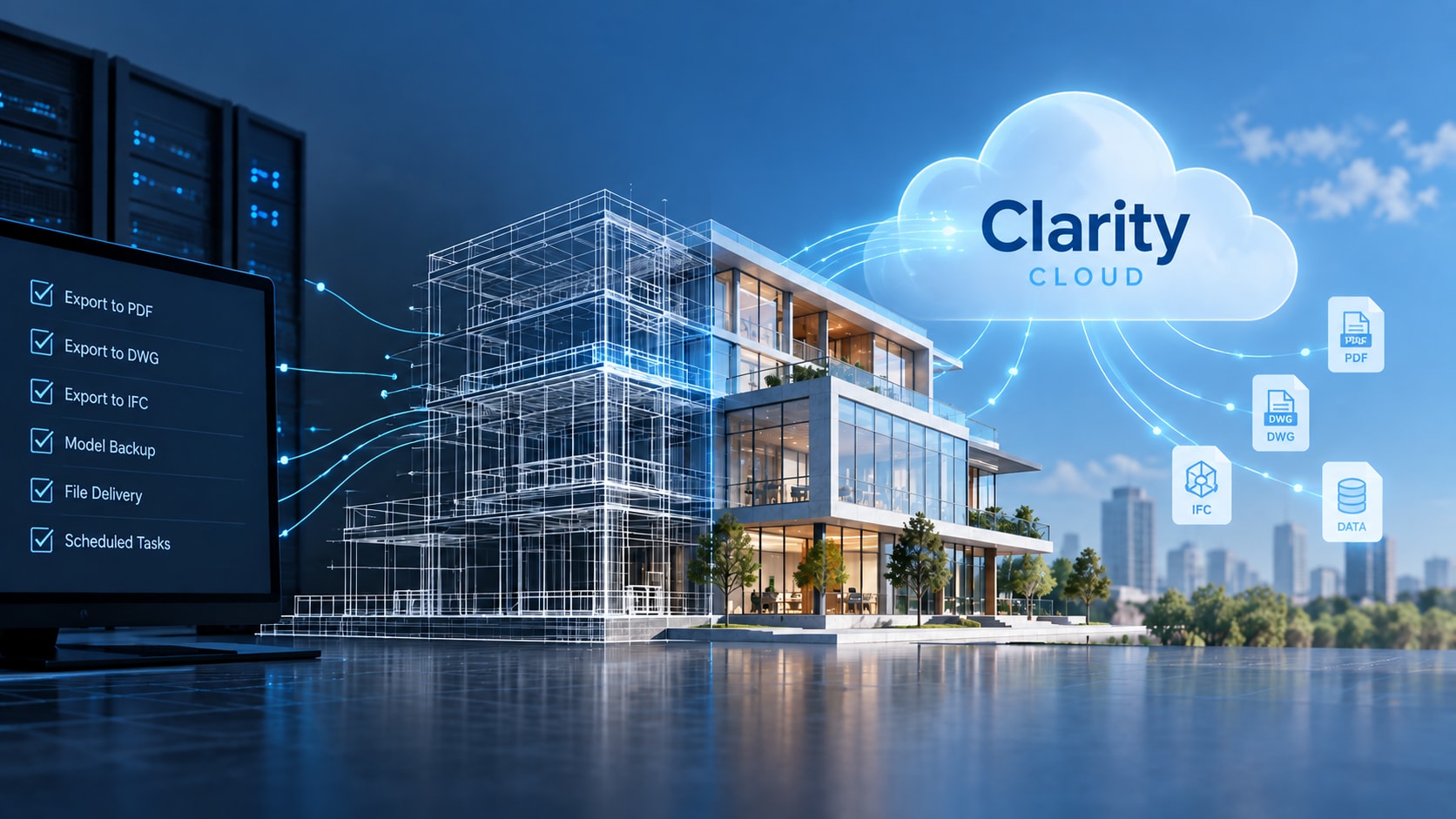
Since 2011, Clarity has helped AEC firms stop babysitting exports and start trusting automation to handle the repetitive work: sitting through an export, restarting a failed job, renaming files by hand before they went out the door. Firms stopped treating automation as a nice-to-have and started building their production standards around it. Across that time, Clarity On Premise has saved customers more than five million hours of processing time, an average of 48 hours per project, per month, time that went back into the work of design and delivery instead of file management.
That's the foundation Clarity Cloud is built on.
A platform that's kept building
Clarity Cloud launched in 2021, added a hybrid deployment option in 2023, and has continued to evolve its architecture and capabilities. More recently, that work has focused on bringing more of Clarity’s on-premise automation functionality to the cloud, with the goal of supporting the full range of automation capabilities while continuing to expand cloud-specific processing options. Each step carries the same idea forward: one platform orchestrating the work, no matter where the processing happens.
AEC firms are facing a different set of pressures now: staffing gaps, schedules that shift under you, data volumes that keep climbing, and technology that changes faster than any one IT team can keep up with alone. Keeping pace requires a platform built to scale and adapt, not one that has to be replaced every time needs change. That's what the cloud makes possible, and it's where Clarity keeps taking automation next.
One platform, three ways to run the work
Desktop tools automate on one machine. Cloud APIs automate one task at a time. Clarity Cloud orchestrates the entire operation, across processing models built to work together instead of forcing a choice:
-
Local task servers, running on a firm's own hardware, for hybrid deployments
-
Autodesk's Design Automation API, for pure cloud processing
-
Internal cloud processing, hosted through IMAGINiT
Right now, the firms running Clarity Cloud split about evenly: half process entirely in the cloud, half keep a dedicated task server running alongside it. Both are fully supported, by design. The right setup depends on the project and the firm, not on picking a side, and every mode runs under the same central scheduling and control instead of becoming a separate tool to manage. That flexibility gives you the power to run processing at the level each project needs, whether that means keeping sensitive work on your own secured network or ramping up cloud processing to meet a deadline.
What that looks like on a real project
Clarity handles the Revit headless task automation firms rely on every day: exporting to PDF, DWG, IFC, and database formats, on a schedule or triggered by an event, without someone kicking it off by hand. Cloud-only processing extends that further, adding capabilities beyond the core export set.
In practical terms, that support looks like this: PDFs delivered on schedule without a last-minute scramble, files moved automatically to where a project needs them, live model data backed up on a routine no one has to remember to run, and the metrics that show whether all of it is actually working.
Some automation tools handle a task or two inside a single application, with little room to adjust. Clarity Cloud was built to do more: turn the deliverables and maintenance work that repeat on every project into workflows a firm can set once and trust from then on.
Built on more than a decade of AEC experience
That capability comes from more than a decade of AEC-specific production experience, not a generic automation tool retrofitted for the industry. It's also, as far as we've seen, a combination no one else in AEC has matched: cloud orchestration, scheduling, automated file delivery to project-designated locations, and hybrid local-and-cloud processing, all in one platform.
The past year alone has brought new task types, faster processing, and clearer notifications when something needs attention, with a roadmap that keeps this moving. This is where the next stage of project consistency gets built: hands-off, scheduled or event-driven, and dependable enough that a firm can stop thinking about it and get back to the work that actually needs their attention.
Processing will change. Orchestration is what endures.
It already has, more than once, over the last decade and a half. What hasn't changed is the need for one platform a firm can trust to run all of it, adapt as the work changes, and keep delivering regardless of where the processing happens. That's the standard Clarity set in 2011, and it's the one Clarity Cloud is built to keep leading.
See where Clarity Cloud fits in your workflow
Whether you’re looking to move more automation to the cloud, maintain a hybrid approach, or simply understand what’s possible today, we can help you find the right path forward. Talk with our team to see how Clarity Cloud can support your projects now and as your automation needs evolve.


